
Pharma Patent Expiry: The Silent Crisis That Companies Still Fail to Fix
Introduction: The Moment Everything Changes
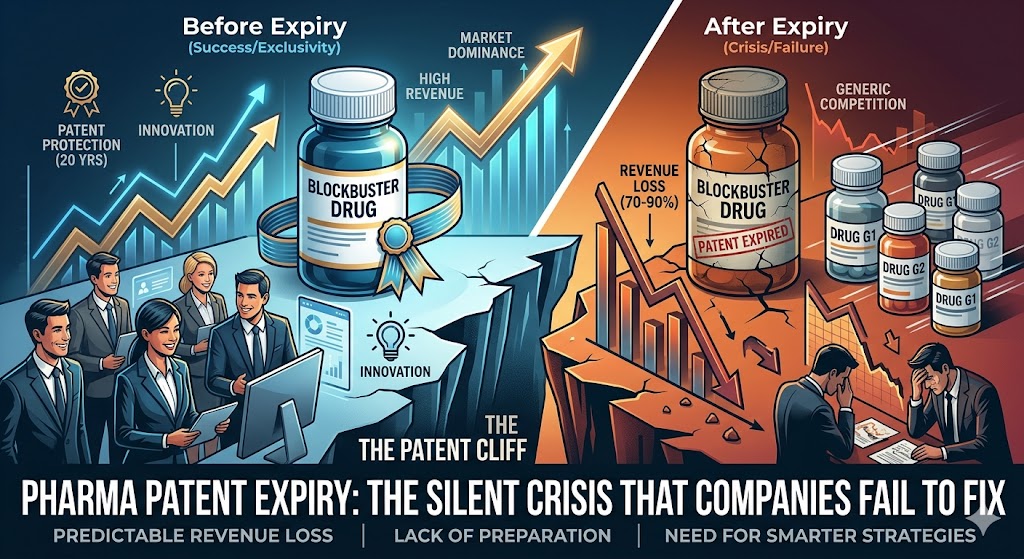
Let’s start with a harsh reality. In pharma, success is often temporary. A drug that generates billions today can lose most of its value almost overnight. Not because it stopped working, but because its patent expired. This moment, often called the patent cliff, is one of the most predictable yet devastating events in the industry.
What makes it even more surprising is that companies know exactly when this will happen. The timeline is clear years in advance. And yet, many still find themselves unprepared, scrambling to recover lost revenue. The issue is not the patent expiry itself. The issue is how pharma companies approach it.
What Patent Expiry Really Means in Pharma
In simple terms, when a pharmaceutical company develops a drug, it is granted a patent that typically lasts for around 20 years. During this period, the company enjoys exclusivity. There is no direct competition, pricing remains high, and margins are strong.
However, once the patent expires, the situation changes instantly. Generic manufacturers enter the market with cheaper alternatives. These generics are chemically identical but significantly lower in price. As a result, the original drug rapidly loses market share.
This shift is not gradual. It is sharp and aggressive. Within months, revenue can drop by 70 to 90 percent. What was once a blockbuster product becomes just another option in a highly competitive space.
Why Patent Expiry Hits Pharma So Hard
The impact of patent expiry is not just about competition. It reveals deeper structural weaknesses in how pharma companies operate. Many organizations rely heavily on a small number of blockbuster drugs. These products become the backbone of their revenue.
While this strategy works well during the patent period, it creates significant risk. When one of these key products loses exclusivity, the financial impact is immediate and severe. The business model, which once seemed strong, suddenly appears fragile.
Another factor is the speed of generic entry. Generic companies are highly efficient and prepared well in advance. The moment a patent expires, they move quickly to capture market share. This leaves very little time for the original company to react.
The Real Problem: Lack of Long-Term Strategy
The biggest issue is not patent expiry itself. It is the lack of preparation. Pharma companies often focus too much on maximizing current revenue instead of planning for the future.
When a drug is performing well, there is little urgency to invest in alternatives. Teams prioritize short-term gains, such as expanding indications or increasing market penetration. While these efforts do generate value, they do not address the long-term risk.
Innovation, which should be continuous, often gets delayed. By the time companies start building new pipelines, the patent expiry is already close. This creates a gap between declining revenue and new product launches, which is difficult to fill.
Why Pharma Keeps Repeating the Same Mistake
Despite knowing the risks, many companies continue to follow the same pattern. One reason is the comfort that comes with blockbuster success. When a product generates consistent revenue, it creates a false sense of security.
Another reason is the complexity of drug development. Developing new therapies requires time, investment, and regulatory approvals. Because of these challenges, companies hesitate to invest early. They wait until it becomes necessary, but by then the window of opportunity has narrowed.
Lack of diversification also plays a role. Companies that depend on a limited number of products are more vulnerable. A single patent expiry can significantly impact their overall performance, exposing the need for a more balanced portfolio.
How Pharma Companies Can Fix the Patent Cliff Problem
The good news is that patent expiry is not an unsolvable problem. With the right strategy, companies can manage and even reduce its impact. The key lies in early planning and smarter execution.
The first step is to start preparing well in advance. Ideally, companies should begin planning five to seven years before a patent expires. This allows enough time to develop new products, explore partnerships, and build alternative revenue streams.
Lifecycle management is another important approach. Instead of treating a drug as a fixed asset, companies can extend its value through innovation. This includes developing new formulations, improving delivery systems, or targeting new patient segments. These efforts help maintain relevance even after exclusivity ends.
Technology, especially AI, can also play a significant role. By analyzing market trends and historical data, AI can help predict revenue decline and identify opportunities. It enables companies to make proactive decisions rather than reactive ones.
Expanding into emerging markets is another effective strategy. Even after patent expiry in developed regions, there is potential for growth in markets where access and affordability are still evolving. Strategic pricing and localized approaches can help capture this opportunity.
Finally, building a strong brand beyond the product itself is critical. When trust and relationships are established with healthcare professionals, the impact of generics becomes less severe. The brand continues to hold value, even in a competitive environment.
The Difference Between Companies That Win and Lose
The way companies handle patent expiry often determines their long-term success. Some organizations treat it as a crisis, while others see it as a transition.
Companies that struggle are usually those that react late, depend heavily on a few products, and focus primarily on short-term performance. In contrast, successful companies plan early, diversify their portfolios, and invest consistently in innovation.
The difference is not in the resources they have, but in how they use them. Strategy, discipline, and foresight play a much bigger role than scale alone.
The Future of Pharma Beyond Patents
The pharma industry is evolving. While patents will continue to be important, they will no longer be the only driver of success. Companies are increasingly focusing on data, digital capabilities, and patient-centric approaches.
This shift means that value will come not just from the drug itself, but from the overall experience and outcomes it delivers. Patient support programs, digital engagement, and real-world evidence are becoming key differentiators.
In this new landscape, companies that rely solely on patents will struggle. Those that adapt and innovate continuously will be better positioned to succeed.
Conclusion: The Problem Is Not the Patent, It Is the Mindset
Patent expiry is inevitable. Every drug will face it at some point. The real question is how prepared a company is when that moment arrives.
Pharma companies do not fall off the patent cliff because they did not see it coming. They fall because they did not act early enough. The solution is not to avoid patent expiry, but to build a strategy that can withstand it.
In the end, the companies that succeed are not the ones with the longest patents, but the ones with the smartest plans.
Frequently Asked Questions (FAQs)
What is patent expiry in pharma?
Patent expiry occurs when a drug loses its exclusivity, allowing generic competitors to enter the market.
Why is patent expiry called a patent cliff?
Because revenue drops sharply and suddenly after generics enter the market.
How can pharma companies prepare for patent expiry?
By investing in new pipelines, lifecycle management, diversification, and early strategic planning.
What role does AI play in managing patent expiry?
AI helps predict market changes, optimize pricing, and identify growth opportunities.
Can companies recover after losing a patent?
Yes, with strong strategy, innovation, and diversification, companies can maintain growth even after patent loss.
About Author

More to Read
Your Regulatory Team will love us.

Requirement
Business Goal

Update
Implementation

Safety Check
Auto-validation

Audit Trail
Ready for Inspection
Requirement
Business Goal
Update
Implementation
Safety Check
Auto-validation
Audit Trail
Ready for Inspection